
An airport never has a convenient downtime. Flights, cargo, ground crews, and security all keep moving while the roof above them ages, leaks, or gets replaced, and that single fact reshapes how aviation roofing has to be planned. Every access point, every material lift, every crew badge has to be arranged around operations that do not stop. On the building itself, the roofs are large, flat, and exposed — long expanses with minimal slope, heavy mechanical loads, and wind and jet-blast forces a standard commercial roof never sees. The work that protects an aviation facility in Baton Rouge is operational coordination and wind-rated detailing, not just a bigger version of a warehouse roof.
Aviation in the Baton Rouge area
Baton Rouge Metropolitan Airport (BTR) off Veterans Memorial Boulevard in the north of the parish is the commercial anchor — the primary passenger airport for the state capital, with a terminal, cargo operations, rental-car facilities, and the supporting buildings that ring an active airfield. Around it sits a layer of general-aviation and aviation-adjacent infrastructure: fixed-base operator hangars, private and corporate hangars, and maintenance facilities. The region's heavy petrochemical corridor along the river drives substantial corporate and cargo aviation activity through the area as well, and Louis Armstrong New Orleans International (MSY), roughly 80 miles southeast, serves as the major international gateway for the broader region. Each of these building types — terminal, cargo, hangar, support — carries a different roof problem under the same coordination umbrella.
What an aviation roof has to withstand
Terminal and airside roofs face loads a typical commercial membrane is not specified for. On airside surfaces, jet-blast and high wind exposure call for adhesion and ballast specifications well beyond what a comparable logistics building would use — a membrane that lifts on an active apron is a foreign-object-debris hazard, not just a roofing failure. The mechanical density on a terminal is high: the HVAC needed to condition a large public concourse means more curbed penetrations and more flashing touchpoints than standard commercial, and each oversized curb and complex through-penetration is detailed individually rather than with a stock pattern. The roofs themselves tend to be long, flat, and minimally sloped, which makes drainage design critical and leaves almost no tolerance for ponding — standing water on a near-flat terminal roof in this climate is a slow failure waiting to happen.
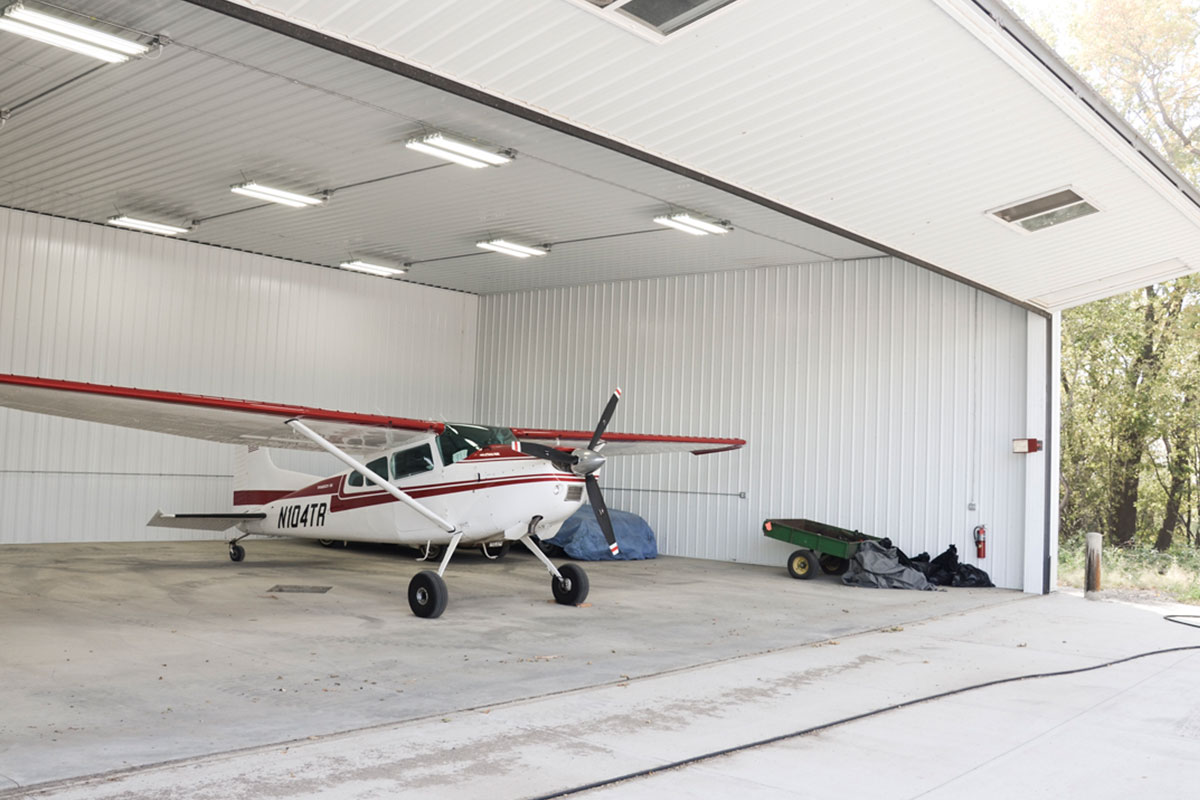
Hangars are a different animal. High-bay structures with wide clear-span roofs, often on pre-engineered building systems or wide-flange steel, generate serious wind-uplift loads and significant thermal movement across a large metal roof plane. The fastening pattern and seam geometry have to be matched to that structure, which is why standing-seam metal is frequently the right call on new high-bay aviation buildings while single-ply suits many terminal and support structures.
Coordinating with an operation that runs around the clock
We build the operational coordination into the scope before the contract is signed, not after mobilization. That means working with the airport facilities department and the FAA Part 139 safety program to develop a phased work plan that operations approves, scheduling material deliveries and any crane lifts into approved windows, and coordinating with the FAA notice process where work could affect the airfield. Crews are badged and credentialed to the access their work requires — landside, and airside where applicable — and we do not put a crew member into a secure or airside area without confirmed authorization. On a terminal, we also sequence the disruptive work to keep noise and access impacts away from active passenger areas as much as the building allows.
Terminal, cargo, and support buildings
Aviation-adjacent buildings — cargo facilities, rental-car centers, FBO hangars, maintenance shops, and any hotel or office structure on an airport campus — each bring their own roofing requirements, but the badging and access requirement never goes away anywhere on the campus. Our pre-project survey documents every penetration, curb height, and mechanical clearance before we develop the work plan, and we plan the security access as a baseline part of the job rather than something discovered on site.
Systems we specify
Most terminal and support-building reroofing in this market uses a TPO or PVC single-ply membrane over a tapered insulation system designed to push water to the drains and end the ponding that plagues large flat roofs. New high-bay structures and hangars frequently call for standing-seam metal. The selection follows the existing deck, the load capacity, the wind exposure, and the operational constraints — we develop the specification after walking the roof with the facilities engineer, not from a catalog.
Airport & Aviation Roofing Questions
How do you schedule work at an operating airport like BTR?
We work with the airport facilities department and the FAA Part 139 coordinator on a phased plan that operations approves. Material deliveries, crane lifts, and any work near airside areas go into approved windows, coordinated with the FAA notice process where required. It is a standard part of our project setup, not an exception.
What roof systems suit large-span terminal roofs?
Most terminal reroofing here uses TPO or PVC single-ply over tapered insulation to improve drainage and address ponding. New high-bay structures and hangars often call for standing-seam metal. The choice follows the existing deck, load capacity, wind exposure, and operational constraints, decided after a walk with your facilities engineer.
How do you handle the density of HVAC penetrations on a terminal?
Terminal mechanical density runs well above standard commercial. Our pre-project survey documents every penetration, curb height, and clearance before the work plan, and oversized curbs and complex through-penetrations are detailed individually rather than with a stock pattern.
Can you work on airside structures near active runways?
Yes, with proper badging and in coordination with airfield operations. Airside work takes more pre-planning and crew credentialing, which we build into the timeline, and we do not mobilize crew members without confirmed airside authorization.
Do you handle hangar roofing for FBOs and general aviation?
Yes. Hangar roofing — from a single-bay private hangar to a multi-unit FBO complex — is a regular part of our work. High-bay structures on wide-flange or pre-engineered systems have specific uplift and thermal-movement characteristics, and we specify and install for them accordingly.