
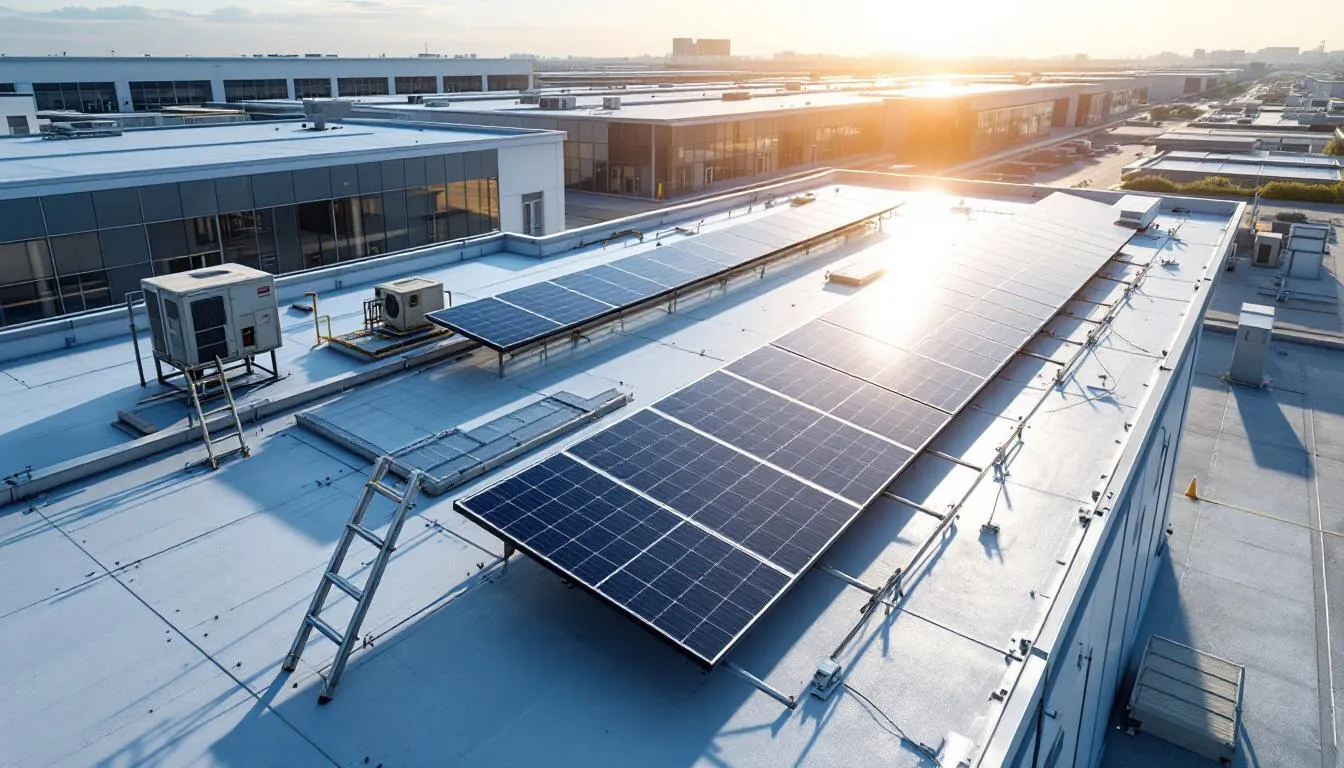
One roof, a dozen different tenants over its life
Flex space is the shapeshifter of the commercial inventory, and its roof carries the scars to prove it. A single building might house a light-manufacturing shop in one bay, a distribution tenant in the next, a contractor's warehouse beyond that, and a tech firm's lab space at the end, with those uses rotating every lease cycle. The roof has to keep performing through every one of those changes, every tenant improvement, and every new rooftop unit that lands without anyone updating the original loading plan. That accumulation, not any single defect, is what makes flex roofing its own discipline.
Baton Rouge has a deep flex-space stock spread across its industrial corridors, and the building eras tell you what you are walking onto. The older tilt-wall and built-up product lines the Airline Highway and Choctaw Drive corridors and the Industriplex and Cloverland areas near the airport. Newer pre-engineered metal flex buildings fill the business parks along the I- and Bluebonnet service districts. Push toward Port Allen, Baker, and the Gonzales and Prairieville growth band and you find still more, much of it multi-tenant and much of it modified well beyond what the property records show.
The penetration count nobody wrote down
Multi-tenant flex buildings face a problem single-user industrial roofs never do: tenant improvement activity that keeps adding rooftop HVAC, punching the membrane for new electrical and mechanical runs, and setting equipment that was never in the original loading plan. None of it is malicious, but a flex roof quietly accumulates years of undocumented modifications. That is why every flex scope we run starts with a penetration inventory survey, photographing and mapping every penetration, comparing it to the original construction documents where they exist, and flagging the non-standard or poorly sealed ones for remediation before any new membrane goes down. Skip that step and you inherit somebody else's leaks under your warranty.
Matching the system to the build era
The reroof spec follows the deck. For the 1970s and 1980s tilt-wall and concrete flex buildings around the airport and Choctaw corridors, 60-mil TPO mechanically attached over new polyiso is the standard, cost-effective answer. On buildings with heavy rooftop equipment density or constant HVAC service traffic from multiple tenants, stepping up to 80-mil TPO or 60-mil PVC fully adhered buys real puncture and traffic resistance that pays for itself. For the pre-engineered metal buildings, a standing-seam recover or a silicone-coated metal system often extends service life without the cost and tenant disruption of a full tear-off.
Wind, water, and the Gulf-Coast reality
Low-slope flex roofs in this market answer to two things our climate hands them: wind uplift and water volume. Baton Rouge sits inside the zone that feels tropical systems pushing up from the Gulf, so fastening patterns and edge-metal detailing have to be designed for real uplift pressures, not a calm-weather minimum, and the perimeter and corner zones get the attention they deserve. On the water side, the intense rainfall these systems bring means drainage cannot be an afterthought. We confirm drains and scuppers are sized and clear and add tapered insulation where bays are holding water, because ponding plus heat is how a flex roof ages a decade early.
Vacancy is when flex roofs leak
The riskiest moment in a flex building's life is the gap between tenants. When a tenant pulls out and the HVAC units come off, the curb openings are usually left under temporary covers that fail within a rain event or two, and a vacant bay collects debris and clogs drains faster than an occupied one. Any flex inspection during a lease transition should confirm curb-cap status, verify former-tenant penetrations are properly sealed, and check that the drains are clear. We build that check into transition inspections so an empty bay does not become a soaked deck before the next tenant signs.
Reporting investors can actually use
Portfolio owners and property managers do not need a roof report they have to translate. For investors running multiple flex properties, we provide standardized condition reports that drop straight into capital planning, so you can compare buildings, prioritize spend, and budget reroofs across the portfolio on one consistent format rather than a different narrative from every contractor.
What helps us scope your flex building
- A bay-by-bay occupancy map and the property management contact list
- Which bays are vacant and which tenants have active rooftop equipment
- The deck and building type, tilt-wall, concrete, or pre-engineered metal
- Where leaks are showing up and any known drainage or ponding issues
- Whether this is a single building or part of a portfolio needing standardized reporting
Industrial Flex Space Roofing Questions
How do you handle undocumented tenant penetrations?
Tenant improvement penetrations on flex buildings are often missing from the building records. Our pre-project survey photographs and maps every penetration, compares it against the original construction documents where they exist, and flags any non-standard or improperly sealed penetrations for remediation before new membrane goes down. That keeps old leaks from ending up under your new warranty.
What membrane is best for a multi-tenant flex building?
60-mil TPO mechanically attached over tapered polyiso is the common, cost-effective choice for tilt-wall and concrete flex buildings here. For buildings with high rooftop equipment density or heavy service traffic from multiple tenants, 80-mil TPO or 60-mil PVC fully adhered is worth the additional cost for its greater puncture and traffic resistance.
How do you coordinate work across multiple tenants with different schedules?
We start with a bay-by-bay occupancy map and lease contact list from property management, identify which bays are active, vacant, or noise- and downtime-sensitive, and sequence the work and daily dry-in around that. Tenants get advance notice but communicate through the property manager rather than directly with the crew.
How do you price flex roofing for investors and property managers?
It is priced per roof square, 100 square feet, based on membrane spec, the condition of the existing assembly, penetration density, and bay configuration, with a fixed-price proposal after a roof walk and core where needed. Portfolio investors receive standardized condition reports they can use for capital planning across multiple properties.
Do you handle standing-seam metal roofs on pre-engineered buildings?
Yes. Pre-engineered metal buildings with standing-seam or R-panel roofs take a different approach than flat membrane. We evaluate metal recover systems, including silicone-coated metal and retrofit standing seam, against full tear-off based on current panel condition, purlin spacing, and load capacity, and we install both approaches here.