
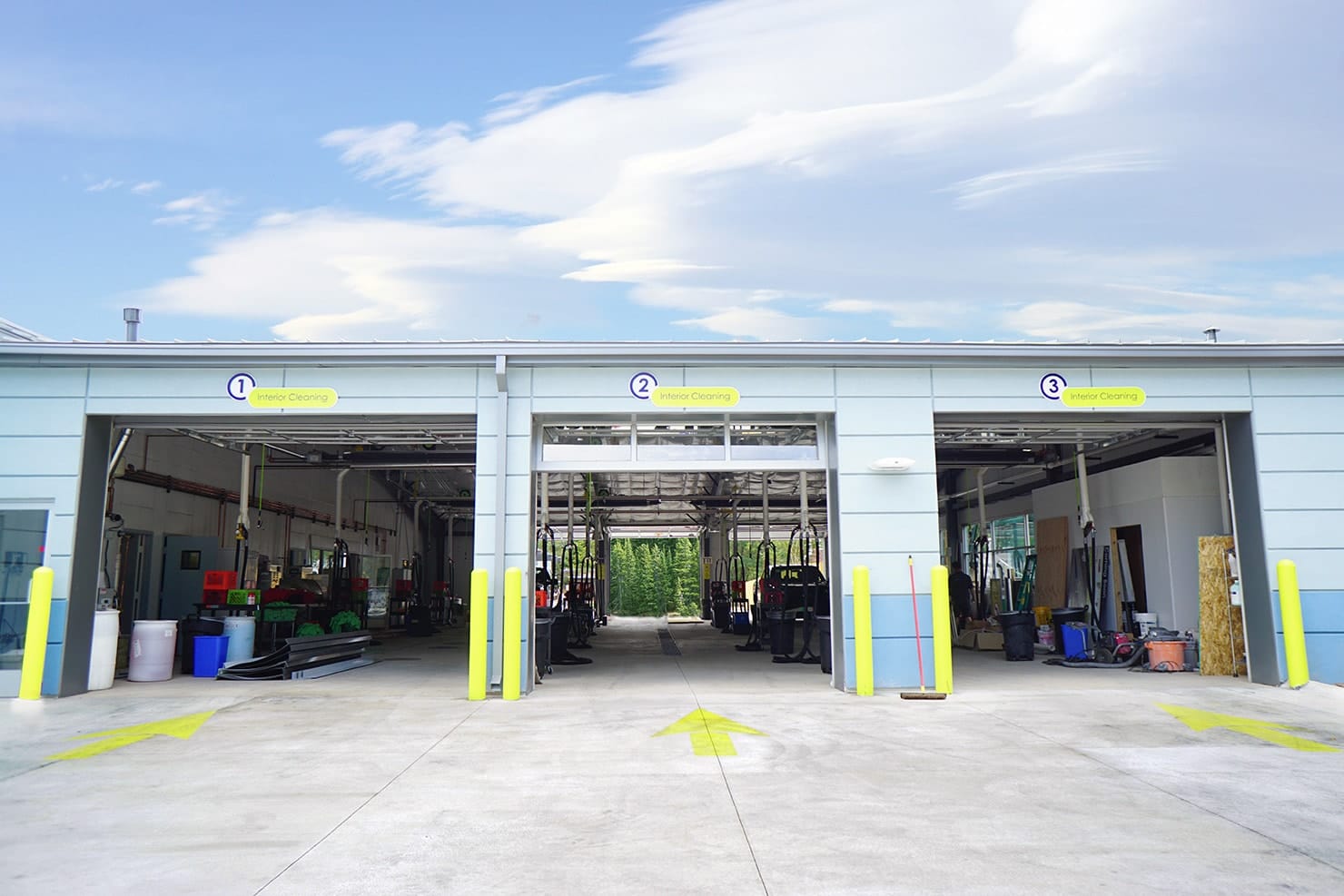
A roof that lives inside a chemical fog
A car wash building punishes its roof from the inside out, and that is the part most contractors miss when they price one like an ordinary retail box. Every wash cycle releases a warm cloud of detergent, presoak, tire-shine solvent, and carnauba wax compounds into the tunnel air. That cloud rises, hits the underside of the deck, and condenses on the steel, the fasteners, and the seams. Over a few seasons it eats fastener heads, blisters adhesive, and corrodes deck flutes from below while the top side still looks fine. Baton Rouge makes it worse: our average summer dew points sit in the low-to-mid 70s, so the humid Gulf air outside has almost no capacity to dry the saturated air a tunnel is pushing out. We build car wash roofs for that reality from the deck up.
Baton Rouge has a dense and growing express-wash market, and the geography of it tells you a lot about the roofs we work on. The Airline Highway and Florida Boulevard commercial corridors carry older in-bay and self-serve sites built in the tilt-wall era. The newer 100-foot express tunnels with the full chemical menu and free-vacuum aprons cluster along Siegen Lane, Coursey Boulevard, Sherwood Forest, and the Highland Road growth band near the I-10 interchanges. Out toward Ascension Parish, the corridor from Gonzales up Highway 30 and along Burnside has filled in with brand-new tunnels chasing the suburban rooftops. Each of those build eras carries its own roofing problem, and we scope them differently.
Why we treat the tunnel bay as its own roof
The enclosure directly over the active wash equipment is the most aggressive roof zone on any building type we touch. It sees steam, alkaline detergent mist, and the thermal whipsaw of hot-water arches firing against the deck. TPO, EPDM, and PVC do not age the same way in that environment. The plasticizer chemistry that keeps PVC flexible is far more resistant to the alkaline soaps and solvent-bearing waxes a commercial wash runs, which is why we lean on a 60-mil fleece-back or fully adhered PVC membrane over the tunnel and confirm the specific chemical program with the operator before we commit. A fully adhered field also kills the membrane flutter that tunnel air pressure causes and removes the fastener penetrations that vapor loves to attack. The rest of the building, the equipment room, the customer lobby, the pay-station islands, does not need that level of armor and we do not overspec it.
Drainage is where in-bay and self-serve sites fail
Express tunnels live or die on chemical resistance. In-bay automatics and self-serve bays usually have lower vapor exposure but a different chronic problem: ponding. A lot of the older bay buildings along the Florida Boulevard and Plank Road corridors were framed flat with internal drains that have since clogged or settled, and standing water sits over the very bays generating the most interior humidity. Ponding plus humid Louisiana heat is how a membrane ages a decade early. We core the assembly, check what the deck is actually doing under load, and design tapered insulation to move water to functioning drains or new scuppers rather than leaving it to evaporate.
Canopies, arches, and the transitions between them
The free-vacuum canopies and the entrance and exit arches are the second front. On the exit side, canopy structures take vehicle exhaust, overspray drift, and full outdoor thermal cycling. Where a canopy ties back into the main building wall, and where the canopy drains connect, is the single most common leak we find on Baton Rouge express sites. Those transitions get re-flashed as discrete details, not painted over. Gantry-mounted signage, LED arch supports, and the conduit runs feeding them all penetrate the membrane and each one is its own flashing item in our scope.
Rooftop equipment built for steam removal
A working tunnel runs high-volume exhaust fans to pull steam and chemical vapor out of the wash. Those penetrations are not standard HVAC curbs and they cannot be flashed like one. The continuous airflow, condensation, and chemical load call for oversized curbs and details matched to the actual equipment. We inspect every penetration on its own terms, the exhaust fans, the reclaim-system vents, the booster-heater flues, and detail each to the duty it sees.
Working around a wash that never closes
Baton Rouge washes run seven days through most of the year, and the unlimited-membership model means downtime is lost revenue with a number attached. We sequence around that. Tunnel-roof work goes in during the early-morning or after-close window so the wash stays watertight before the first car of the day. Canopy, vacuum-island, and main-building work can run during operating hours with traffic control and crew positioning that keeps the customer lanes clear. Daily dry-in is confirmed before we leave the site so a pop-up Gulf storm never finds an open seam.
What helps us scope your wash faster
- The chemical program in use, which presoaks, detergents, and wax products run through the arches
- Wash format, express tunnel, in-bay automatic, or self-serve bays, and the approximate tunnel length
- Where leaks or ceiling staining are showing up inside the tunnel or equipment room
- Canopy and vacuum-island layout and any known drainage or transition issues
- Membrane warranty paperwork from the original build, if you have it
Car Wash Roofing Questions
What membrane do you specify for a car wash tunnel bay?
For the tunnel enclosure we lean on 60-mil PVC, fleece-back or fully adhered, because PVC stands up to the alkaline detergents and wax compounds in a commercial wash program far better than TPO or EPDM over the long run. Adhering it fully also removes the fastener field and membrane flutter that tunnel air pressure creates. The lobby, equipment room, and canopy areas typically take standard mechanically attached single-ply, since they do not see the same vapor load.
Why does chemical exposure void so many roofing warranties?
Most single-ply manufacturers carry a chemical-exposure exclusion in their standard warranty language. Before we set a tunnel membrane, we confirm with the manufacturer that the specific products you run are compatible with the system and that the warranty actually covers your operating conditions. Several manufacturers offer chemical-exposure or wash-specific warranty options, and we identify those during the specification stage.
How do you handle the exhaust fans over the wash tunnel?
Steam-removal fans move a lot of warm, chemical-laden air continuously, so they get oversized curbs and flashing details built for that duty rather than a generic HVAC curb. We walk every penetration, the exhaust fans, reclaim vents, and booster flues, and detail each one to the equipment and the conditions it sees.
Can the wash stay open while you work?
Yes, with sequencing. We put tunnel-roof work in the early-morning or after-close window so the wash is watertight before opening, and run canopy and main-building work during business hours with traffic control keeping the customer lanes clear. We confirm dry-in daily so an afternoon storm never catches an open seam.
Do you cover the vacuum canopies and entrance arches too?
Yes. Free-vacuum canopies, entrance and exit arches, and the transitions where those structures meet the main building are all in our assessment. Canopy membrane or panel replacement, gutter and downspout work, and canopy-to-building flashing repair are standard scope items, and those transitions are usually where we find the leaks.