
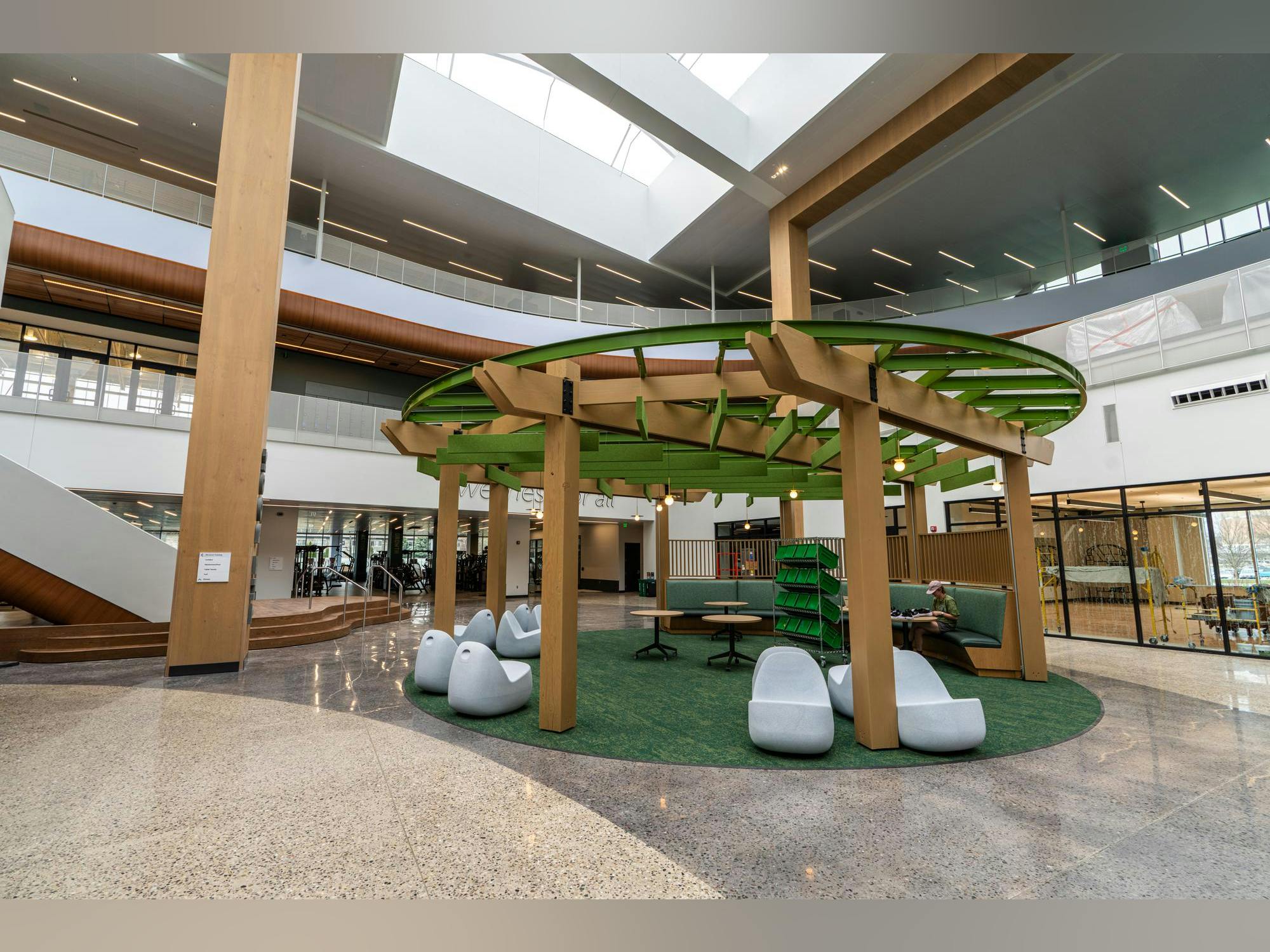
Walk a gym roof and two things stand out immediately: it is mostly one big open span, and it is covered in mechanical equipment. Those two facts drive almost every decision we make on a fitness center. A packed training floor on a January evening puts hundreds of bodies under one clear-span deck, which means the building moves a lot of air, and that air carries heat and moisture that have to go somewhere. Combine that with the showers, the pool if there is one, and the steam rooms, and you have a building that fights its own roof from the inside. The work that keeps a Baton Rouge gym dry is managing moisture and a heavy rooftop equipment count, not just laying a clean field membrane.
The gym market across Baton Rouge
Fitness is everywhere in this market, and the building types vary widely. Big-box clubs anchor retail centers along the Siegen Lane and Bluebonnet Boulevard corridors and out toward Perkins Road. National and regional brands — the kind of 24-hour and high-volume operations you find off Airline Highway and Coursey Boulevard — sit in standalone boxes with enormous open floors. Boutique studios and CrossFit-style gyms have filled in smaller retail bays through Mid City and the downtown fringe. Campus and recreation fitness near LSU adds large institutional facilities to the mix. Whether it is a 40,000-square-foot club or a converted retail suite, the roofing problem scales with the open span and the occupancy load underneath it.
The moisture problem most owners never see coming
The first leak complaint on a fitness center is often not a leak at all — it is condensation. High-humidity interior spaces drive water vapor up into the roof assembly from below, and in our hot, humid climate that vapor will find the cold surfaces inside the deck and condense there regardless of how tight the top membrane is. If the vapor retarder is in the wrong position for this climate zone, the result is trapped moisture, ruined insulation R-value within a few seasons, and stains that look exactly like a roof leak. We review the existing assembly and the vapor retarder position before we specify a reroof, and on buildings with pool or steam areas we treat vapor control as a designed layer, not an accessory.
A roof covered in equipment
High occupancy demands high-volume air handling. The open training floor needs heavy ventilation to manage the heat and carbon dioxide that a crowd generates, and the group-exercise rooms, locker rooms, and any pool enclosure each carry their own dedicated units with rooftop supply and exhaust. The result is a penetration count that often runs two to three times what a retail box of the same footprint would have. Every one of those curbs and penetrations is a place water can get in, and the humidity inside the building means the standard flashing detail is not always enough. We document every curb, height, and clearance before pricing, and we raise or replace the undersized curbs — a common defect on older gym buildings — so the new membrane meets the manufacturer's warranty height requirements.
Working around a building that never closes
Plenty of these clubs run from before dawn to past midnight, and the 24-hour locations never close at all. We coordinate the work schedule with the facilities team before mobilization, confirm tear-off and dry-in windows in writing each day, and give the gym manager a daily status so they can verify watertight protection before the next busy cycle. Crew start times and noise limits near occupied locker rooms are set in the pre-construction plan, and where a pool is involved we coordinate any exhaust or HVAC work with the pool operations team so air quality stays in compliance.
Systems we specify
For gyms with pool enclosures or steam rooms, a 60-mil TPO or PVC fully adhered system is our preferred specification — the adhered assembly eliminates the fastener field of a mechanically attached roof and gives a more vapor-resistant build at the membrane. For dry buildings without aquatic spaces, mechanically attached 60-mil TPO over polyiso is appropriate and more economical. Over a long clear span, the attachment is engineered to the actual deck type and span, because the fastener design over an 80-foot bay is not the same as over a 30-foot one. Chain locations get closeout documentation formatted to match their corporate facility systems; independent owners get the same permit records, warranty, drain report, and roof zone diagram for their own files.
Fitness Center & Gym Roofing Questions
How do you handle condensation from pools and locker rooms?
Interior vapor drive needs a vapor retarder positioned correctly within the assembly for this climate zone, not just a tight top membrane. We review the existing insulation and retarder position before specifying a reroof. Getting it wrong traps moisture that destroys insulation R-value within a few seasons.
What membrane works best for a fitness center?
For gyms with pool or steam areas, 60-mil TPO or PVC fully adhered is preferred — the adhered build is more vapor-resistant and removes the fastener penetration field. For dry buildings, mechanically attached 60-mil TPO over polyiso is appropriate and more economical.
Can you work around 24-hour and early-morning hours?
Yes. We set the schedule with the facilities team before mobilization and confirm tear-off and dry-in windows in writing each day. The manager gets a daily status to verify watertight protection before the next busy cycle, and noise limits near locker rooms are documented up front.
Is rooftop HVAC curb work part of the scope?
Yes. Curb flashing is standard on any gym reroof. We document every curb, size, and clearance before pricing, and undersized curbs — common on older buildings — are raised or replaced so the membrane meets the manufacturer's warranty height.
What do you provide at closeout?
Permit and final inspection, manufacturer warranty registration, a roof zone diagram with penetration inventory, a drain and flashing inspection record, and photo documentation. Chain operators receive it formatted for their corporate facility management system.