
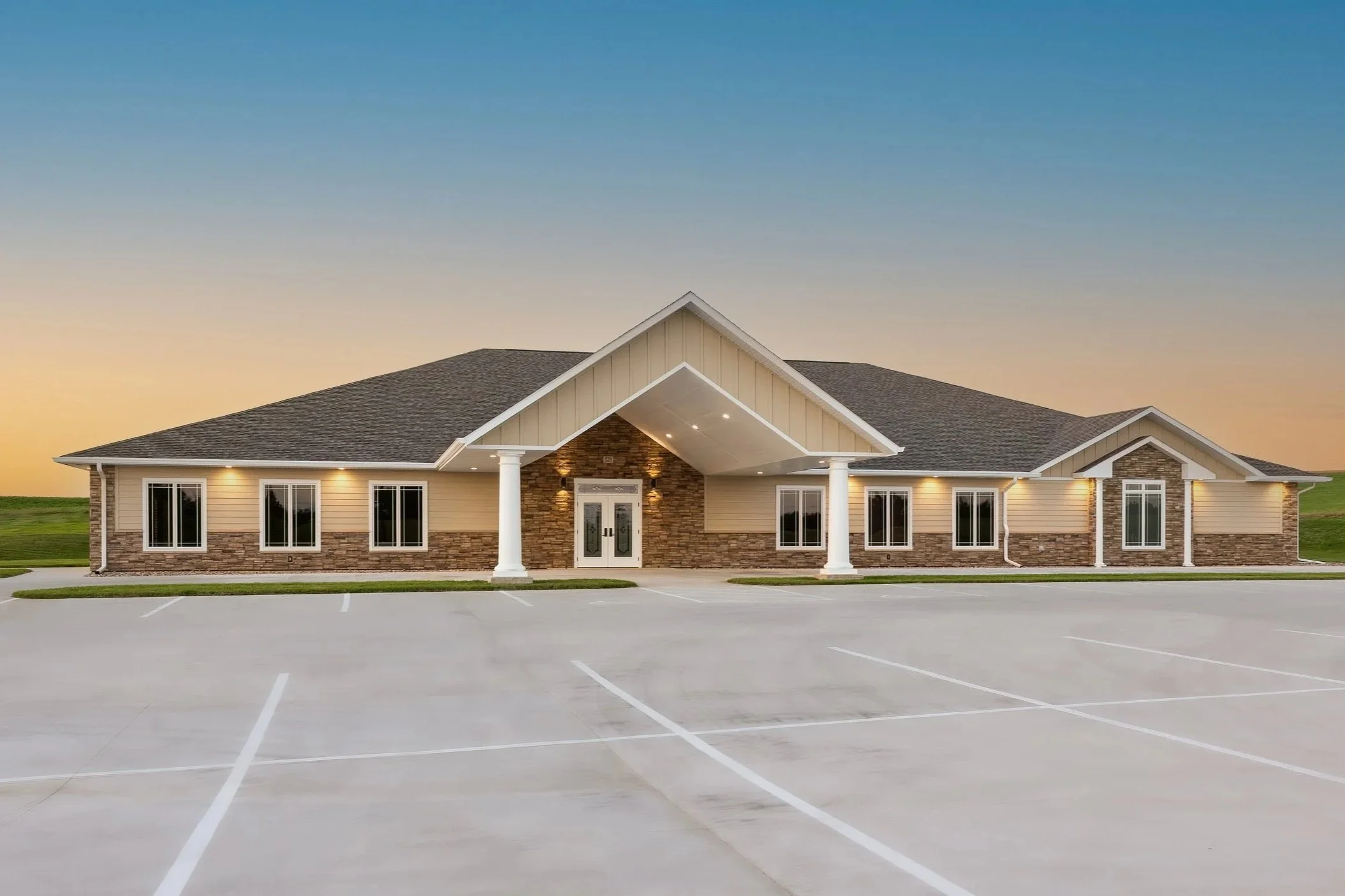
A funeral home is the rare commercial building where the roof has two jobs that pull in opposite directions. It has to perform like any other low-slope membrane in south Louisiana — shedding the downpours that roll off the Gulf, surviving the heat radiating off the parking lot all summer, holding up against the wind that comes with every named storm season. But it also has to be invisible. No family arriving for a visitation should hear a generator, see a debris chute over the entry, or notice a tarp flapping above the chapel. We roof funeral homes and mortuaries around Baton Rouge with both of those jobs treated as non-negotiable from the first site walk.
Funeral facilities across the Baton Rouge area
The funeral and mortuary trade in this market is spread across the older established neighborhoods and the newer suburban corridors alike. Long-standing family chapels sit along Government Street and through the Mid City and Goodwood neighborhoods, many of them in buildings that have served the same families for generations. Newer purpose-built facilities have followed the population out toward the Sherwood Forest, Jefferson Highway, and Coursey Boulevard areas, and south toward Prairieville and the Highland Road corridor. Regional and chain-operated locations cluster near the busier arteries off Airline Highway and Florida Boulevard. The buildings range from small single-chapel operations to large facilities with multiple visitation rooms, an on-site crematory, and a covered porte-cochere wide enough for a procession to stage under cover — and each of those configurations changes what the roof has to do.
What a mortuary roof actually has to handle
The preparation and embalming areas are the part of the building most owners worry about least and should worry about most. These rooms run continuous mechanical exhaust to control formaldehyde and other vapors, and that exhaust terminates on the roof. The stack cannot be capped, blocked, or shut down for our convenience — the ventilation has to keep running while we work around it. We locate every prep-room exhaust point before mobilization and treat the flashing at each one as its own scope item, coordinated with the funeral director so the system never goes offline. A leak over a preparation room is not a nuisance; it is a problem that touches licensing, dignity, and the family's trust all at once.
The chapel and visitation rooms bring a different challenge. These are often clear-span spaces, forty to sixty feet across with no interior columns, which generates real wind-uplift load on the membrane and the deck attachment. We confirm the deck type — steel, wood, or concrete — and the existing fastening before we specify anything, because the uplift design over an open chapel is not the same as over a tight back-of-house office. On the older Government Street and Mid City buildings we frequently find aged built-up or modified-bitumen roofs on wood or concrete decks, where a serviceable-looking surface hides wet insulation underneath. Core samples and a moisture survey come before any recover decision, every time.
Then there is the porte-cochere. The covered drive where families are received is almost always where the chronic leaks live, because the canopy-to-building transition takes thermal movement, settlement, and runoff all at the same junction. We evaluate that transition and its drainage as a discrete item on every funeral home roof, rather than assuming a field membrane replacement will fix a flashing problem.
Working without disrupting a single service
Visitations run into the evening seven days a week, and a service can be scheduled on short notice when a death call comes in. That reality drives our entire approach. We get the funeral director's calendar, sequence the loud and dusty work away from active service areas and active service hours, and confirm a watertight dry-in before the building closes each evening so a surprise overnight storm never reaches the interior. We stage materials and access away from the primary entrance and chapel, keep the crew presentation appropriate to where they are working, and keep the front of the building looking the way a grieving family expects it to look.
Materials and systems we specify
For most flat-roofed funeral homes in the Baton Rouge climate, a 60-mil TPO or PVC membrane over tapered polyiso insulation is the workhorse specification. The tapered insulation corrects the drainage shortfalls that plague older under-drained low-slope roofs, eliminating the ponding that quietly degrades a membrane through our long hot summers. Where a building has a steep chapel roof or a decorative front, we match the visible roofing to the appearance the facility needs to maintain. On wood-decked chapels we verify load capacity before we commit to an insulation thickness or attachment pattern.
Funeral Home & Mortuary Roofing Questions
How do you work around visitations and services?
We schedule against the funeral director's weekly calendar. We receive advance notice of services and visitations, sequence the disruptive work away from those windows, and confirm a watertight dry-in before the building closes each evening. We keep the primary entry, chapel, and porte-cochere clear of crew and equipment during service hours.
How do you handle the preparation room exhaust?
Prep-room and embalming exhaust stays operational the entire project. We locate every exhaust point before mobilization, flash each one as a separate coordinated scope item, and never cap or shut down the ventilation for roofing convenience.
What roof system do you usually recommend?
For flat-roofed funeral homes in Baton Rouge, 60-mil TPO or PVC over tapered polyiso is the typical specification. The taper corrects drainage and ends ponding. Chapel and decorative roof areas are matched to the appearance the facility needs to keep.
Do you handle clear-span chapel roofs?
Yes. Open chapel spans generate higher wind uplift, so we confirm deck type and existing attachment and design the fastening to the actual span and deck before specifying the system.
Can you address the porte-cochere?
Yes, and we look at it closely. The canopy-to-building transition and its drainage are the most common chronic leak source on funeral homes, so we evaluate and re-flash that junction as its own scope item rather than assuming a field replacement will solve it.