
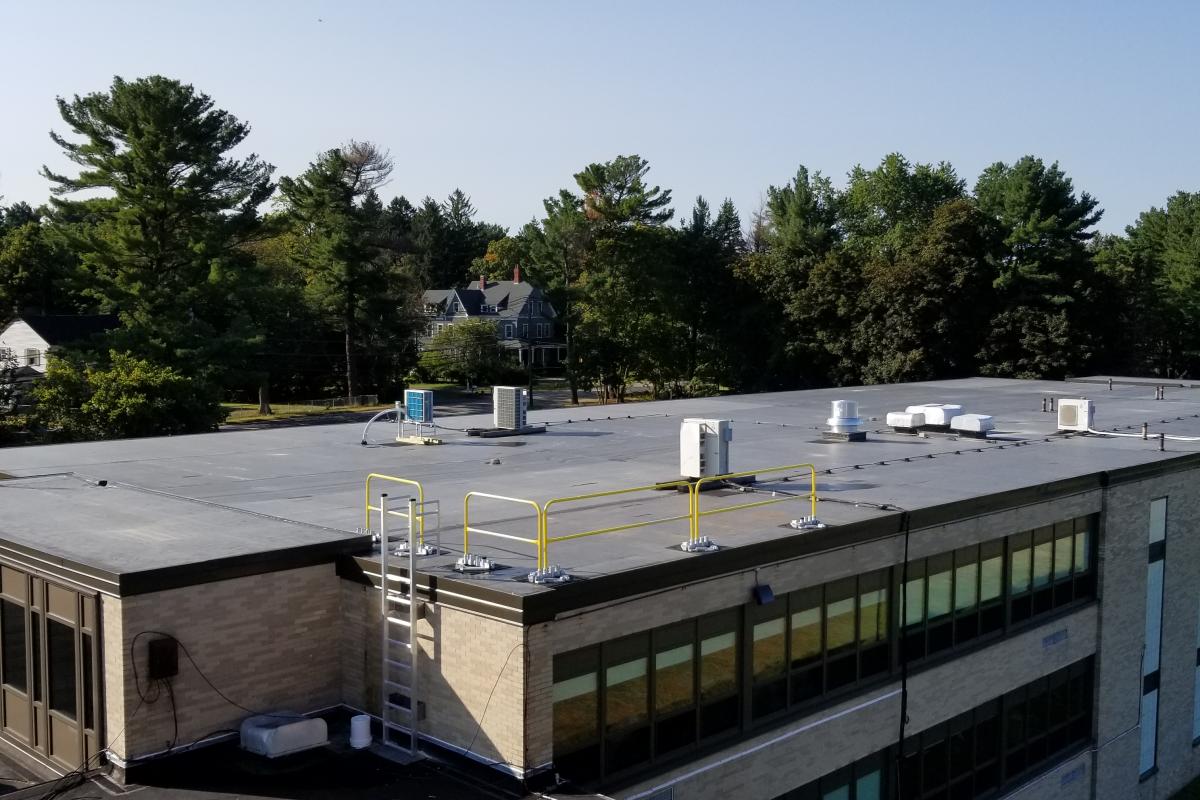
Baton Rouge's consolidated City-Parish government structure — a unique Louisiana creation merging the City of Baton Rouge and East Baton Rouge Parish under a Plan of Government first adopted in 1947 and revised most recently in 2009 — means that roofing procurement for government buildings falls under a single entity, the City of Baton Rouge and Parish of East Baton Rouge, administered through the Parish Finance Department's Division of Administration. This consolidated structure owns a building portfolio spanning the Governmental Building Complex on St. Louis Street, the Parish Library's main branch and 13 neighborhood branches, the Metro Council chambers, East Baton Rouge Parish School Board administrative facilities, the Baton Rouge Police Department's main station and five district offices, and the Baton Rouge Fire Department's 29 stations serving a metro area stretching from Old South Baton Rouge to the fast-growing Zachary and Central corridors. Louisiana Revised Statutes Title 38 governs public works contracts for this consolidated government, and the Division of Administration's procurement officers enforce RS 38:2211 through RS 38:2296 without exception.
Louisiana's Public Bid Law under RS 38:2211 requires sealed competitive bidding for public works contracts above $150,000, with the invitation to bid published in the official journal of East Baton Rouge Parish — currently the Baton Rouge Business Report's official journal service — for two consecutive weeks before the bid opening. Louisiana does not have a statewide prevailing wage law equivalent to federal Davis-Bacon, but projects receiving HUD Community Development Block Grant funding through the Parish's Housing and Urban Development Division or EPA Clean Water State Revolving Fund grants trigger federal wage determination compliance. The Division of Administration's federal programs coordinator identifies which wage determination applies and posts it in the official bid documents; contractors who submit bids without reviewing the applicable wage schedule risk underbidding labor costs on federally assisted portions of the contract.
Baton Rouge's subtropical climate imposes roofing challenges shaped by some of the highest annual rainfall totals among major American metropolitan areas. The metro averages 63 inches of annual precipitation, with August frequently delivering hurricane-season remnants that arrive as multi-day rainfall events dumping 10 or more inches, and the flat terrain of the Mississippi River floodplain means that storm drainage overwhelms municipal infrastructure during these events. Government buildings in the Old South Baton Rouge corridor — including the Old State Capitol, several parish court facilities, and the BRPD main station — have experienced repeated interior flooding from roof drain backflow during extreme events, and the Parish's engineering standard now requires dual-level overflow drainage on all publicly funded roofing projects. We install two-tier overflow systems that drain independently of primary drains at each low-point location, verified against the Parish engineer's 100-year storm design event rather than the code minimum 25-year storm used in drier markets.
Hurricane preparedness is the defining criterion for Baton Rouge government building roofing specifications, more so than for any other inland Louisiana city given Baton Rouge's experience absorbing direct impacts from Katrina's remnants in 2005, Gustav in 2008, and the catastrophic August 2016 flood event that caused an estimated $10 billion in statewide losses. The Parish's post-2016 Capital Improvement Plan explicitly requires that government building roofing replacements include enhanced wind uplift resistance designed to the ASCE 7 Wind Speed Map for Baton Rouge's Exposure Category C classification, which translates to a 150 mph design wind speed. We specify fully adhered membrane systems with FM Global approval ratings for 1-75 (75 psf uplift resistance) as a minimum on all Parish government roofing, well above the code-minimum 45 psf that many roofing contractors use as their default design basis.
The Old State Capitol, an 1849 Gothic Revival castle-form structure on the Mississippi riverfront that serves as the Old State Capitol Museum, is a National Historic Landmark whose roofing requires coordination with the Louisiana Division of Historic Preservation at the Department of Culture, Recreation and Tourism and federal Section 106 consultation for any project involving federal funding. The building's original slate roof was replaced with synthetic slate in a 1990s restoration, and the LDHP has documented this earlier restoration as itself now being a character-defining feature that any future roofing work must address with equal care. We maintain a working relationship with the LDHP's architectural staff and have submitted pre-application documentation on three Louisiana NHL properties, understanding the ACHP notification requirement that NHL status triggers beyond the standard Section 106 consultation.
Baton Rouge Fire Department's in Downtown Baton Rouge — a 1940s masonry structure with a flat built-up roof that has been patched repeatedly over decades without comprehensive assessment — and modern stations in the Gardere Lane and Baker corridors built under the 2010s Capital Improvement Program. The newer stations incorporate TPO membranes with integrated rooftop HVAC platforms whose equipment curb flashings are the most maintenance-intensive element of the assembly. We include curb flashing inspection and resealing as part of our standard annual maintenance program on Fire Department stations, providing the BRFD's Facilities Coordinator with an annual inspection report that documents curb conditions and provides early warning of failures that would otherwise become emergency repair calls during hurricane season.
Louisiana's humidity creates a specific moisture management challenge for Baton Rouge government building insulation assemblies. Polyisocyanurate insulation — the standard high-R-value choice for commercial flat roofing — loses effective R-value at low temperatures, but more critically in Louisiana's climate, it absorbs moisture over time from the consistently high-humidity environment, reducing thermal performance by 15 to 25 percent over a decade. We core-sample all existing insulation assemblies on Baton Rouge government buildings before specifying new assemblies to quantify in-place moisture content and design new insulation strategies that include a vapor retarder positioned above the deck for interior-humidity-dominated buildings like libraries and public lobbies, preventing the condensation cycle that has caused deck corrosion on several Parish buildings despite successive membrane replacements.
The Parish Library's main branch on Goodwood Boulevard and the Greenwell Springs Road, Baker, and Central branch libraries serve communities with active after-hours programming that requires contractors to manage exterior work around evening hours when the parking lots are occupied for library events. The Library's Branch Operations Director coordinates construction scheduling as part of the standard capital project process, and re-roofing contractors must attend a pre-construction meeting with Library staff before mobilizing to review the programming calendar and identify the dates when noise-generating operations must be curtailed. We include a Library liaison communication protocol in our project management plan, designating a single point of contact who provides the Branch Operations Director with weekly look-ahead schedules every Thursday afternoon, enabling Library staff to plan programming adjustments without the last-minute conflicts that have historically created friction between contractors and Library administration on Parish construction projects.
The bonding requirements under Louisiana's Public Bid Law for Parish roofing contracts require a bid bond of 5 percent of the bid amount, a performance bond of 100 percent of the contract, and a payment bond of 100 percent of the contract, all from sureties licensed to conduct business in Louisiana under the Louisiana Department of Insurance's certification. The performance and payment bond forms must match the Division of Administration's prescribed AIA A312 format, and sureties that submit bonds on non-standard forms face rejection by the Parish's legal department during contract execution review. Our surety carrier uses pre-approved Louisiana format bonds that have been cleared by the Parish's legal counsel on three prior Parish projects, eliminating the two-to-three-week form negotiation delay that commonly stretches the period between bid award and notice to proceed on Parish government construction contracts.
- What is Louisiana's Public Bid Law threshold for Baton Rouge City-Parish roofing contracts?
- Louisiana Revised Statutes RS 38:2211 requires sealed competitive bidding for public works contracts above $150,000, published in the official journal of East Baton Rouge Parish for two consecutive weeks before bid opening. The consolidated City-Parish government follows this statute without exception, and projects below the threshold may use informal procurement methods as defined in the Division of Administration's purchasing policy.
- How does Baton Rouge's hurricane exposure affect roofing specifications for government buildings?
- The Parish's post-2016 Capital Improvement Plan requires government building roofing designed to ASCE 7 Wind Speed Map requirements for Baton Rouge's Exposure Category C, which translates to a 150 mph design wind speed. Fully adhered membrane systems with FM Global uplift ratings of at least 1-75 are the Parish's standard for municipal facilities, substantially exceeding the code-minimum uplift resistance that many contractors use as their default specification.
- Are there prevailing wage requirements for Baton Rouge City-Parish roofing contracts?
- Louisiana does not have a statewide prevailing wage law, so non-federally-funded Parish roofing contracts use competitive market wages. Projects receiving federal funding such as HUD Community Development Block Grants or EPA SRF grants trigger Davis-Bacon compliance with DOL wage determinations for East Baton Rouge Parish, and the Division of Administration's federal programs coordinator posts the applicable wage determination in the bid documents.
- What drainage design standard does the Parish require on government building roofing projects?
- Following repeated roof drain backflow events during extreme rainfall, the Parish's engineering standard requires two-tier overflow drainage systems on all publicly funded roofing projects, with primary and overflow drains operating independently at each roof low point. The drainage design must be sized for the Parish engineer's 100-year storm event rather than the IPC minimum 25-year event, which translates to significantly larger overflow scuppers or secondary drain pipe sizing.
- What bond forms does Louisiana's Public Bid Law require for Parish roofing contracts?
- Louisiana law requires a 5 percent bid bond, a 100 percent performance bond, and a 100 percent payment bond, with performance and payment bonds typically required on the Division of Administration's prescribed AIA A312 format. Sureties must be licensed by the Louisiana Department of Insurance, and non-standard form bonds submitted by sureties unfamiliar with the Parish's preferred format are rejected during contract execution review, causing delays between award and notice to proceed.