
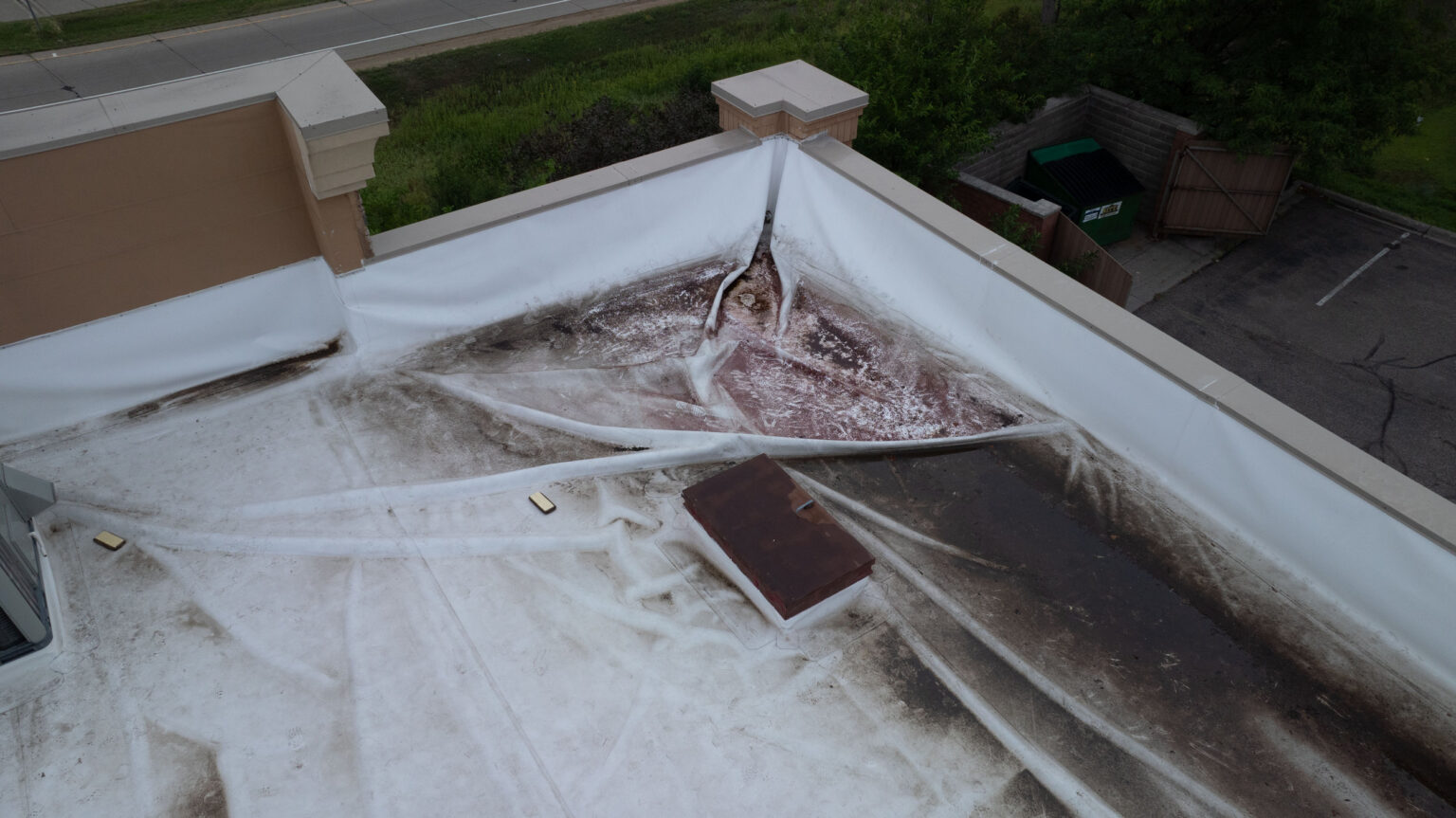
Insurance claim coordination, on our end, is the logistics work that sits between "the roof got damaged" and "the repair is approved and scheduled." A property manager or building owner calls after a storm, a leak that turned out to be storm-related, or damage a tenant reported, and the first thing we sort out is timing: when the adjuster can get on site, what needs to be inspected before anyone touches the roof, and what has to be recorded before cleanup or emergency dry-in changes the scene.
Before an adjuster ever sets foot on the roof, we walk it ourselves. That first pass covers deck access, drainage, curbs, wall transitions, prior repair patches, and any interior leak locations reported below. We photograph systematically by roof area rather than grabbing a handful of general shots, and we take moisture readings anywhere intrusion is suspected. That file becomes the basis for the conversation with the adjuster, not a set of notes we're reconstructing from memory later.
Scheduling the adjuster walkthrough is where coordination earns its name. We try to be on the roof at the same time as the adjuster so field questions get answered on the spot instead of through a slower round of emails afterward. For occupied buildings — offices along the Bluebonnet/Siegen corridor, retail on Airline Highway, tenant-occupied warehouses near the river — we also work around business hours and access restrictions so the inspection does not turn into its own disruption.
Baton Rouge's climate makes the documentation side genuinely harder than it would be in a milder market. Near-constant humidity and long stretches of intense UV exposure age membranes steadily, which means a roof can show general wear that looks similar to storm damage if you are not looking closely. Part of what we bring to the adjuster meeting is the ability to point to the specific failure — a fresh tear versus a brittle seam that finally let go, a new puncture versus an old, re-opened patch — so the claim reflects what the storm actually did.
A complete scope has to go beyond the membrane. We review insulation condition, recovery board, penetrations, rooftop mechanical curbs, edge metal, drain strainers, and overflow paths, and we note where code requires an upgrade during repair so that requirement is part of the conversation from day one instead of a change order that surprises everyone mid-project.
Petrochemical corridor and industrial properties along the Mississippi River add their own coordination wrinkles — contractor access rules, safety orientation requirements, and work-hour restrictions that a downtown office building doesn't have. We build those constraints into the inspection and scheduling plan up front so the claim process doesn't stall on a site-access issue nobody flagged early.
Documentation does not stop once the scope is agreed. We keep photos, repair locations, product information where applicable, and closeout notes organized through the life of the project, because that same file tends to get reused later — for warranty conversations, for a future capital planning cycle, or for a lender review if the building changes hands.
We are careful about the line we do not cross. We do not tell an owner what their policy covers, we do not negotiate settlement value with the carrier, and we do not promise a particular payout. What we control is the accuracy and completeness of the roof-side documentation, and we treat that as the whole job.
We're your roofing contractor, not a public adjuster — we document and substantiate the roof damage so you and your adjuster work from an accurate scope. For the fuller claims picture, see commercial roof insurance claims, or the peril-specific pages for hurricane damage and wind and storm damage. Commercial Roofers of Baton Rouge can be reached at 225-340-2357 to get an adjuster walkthrough scheduled.
Common Roof Planning Questions
How fast can you get to the roof after damage is reported?
We prioritize active leaks and open roofs first. For a scheduled adjuster walkthrough, we typically need a day or two of lead time to complete our own inspection first.
Do you attend the adjuster meeting with us?
Yes, when scheduling allows. Being on the roof together lets us answer field questions directly instead of relaying everything through photos and notes afterward.
Will you tell me what my policy covers?
No — that's a question for your agent or adjuster. We can tell you what we found on the roof and how it ties to a cause of loss; coverage interpretation is outside our role.
What if the adjuster's scope misses something you documented?
We can go back up with the additional photos or measurements and provide that documentation to you or your agent to support a follow-up review.
Can coordination happen while the building stays occupied?
Most inspections and adjuster walkthroughs can be scheduled around business hours and tenant access needs. We plan around that from the first call.
What happens after the scope is approved?
We move into the repair or replacement itself, using the same documented scope so the completed work matches what was approved on the claim.