
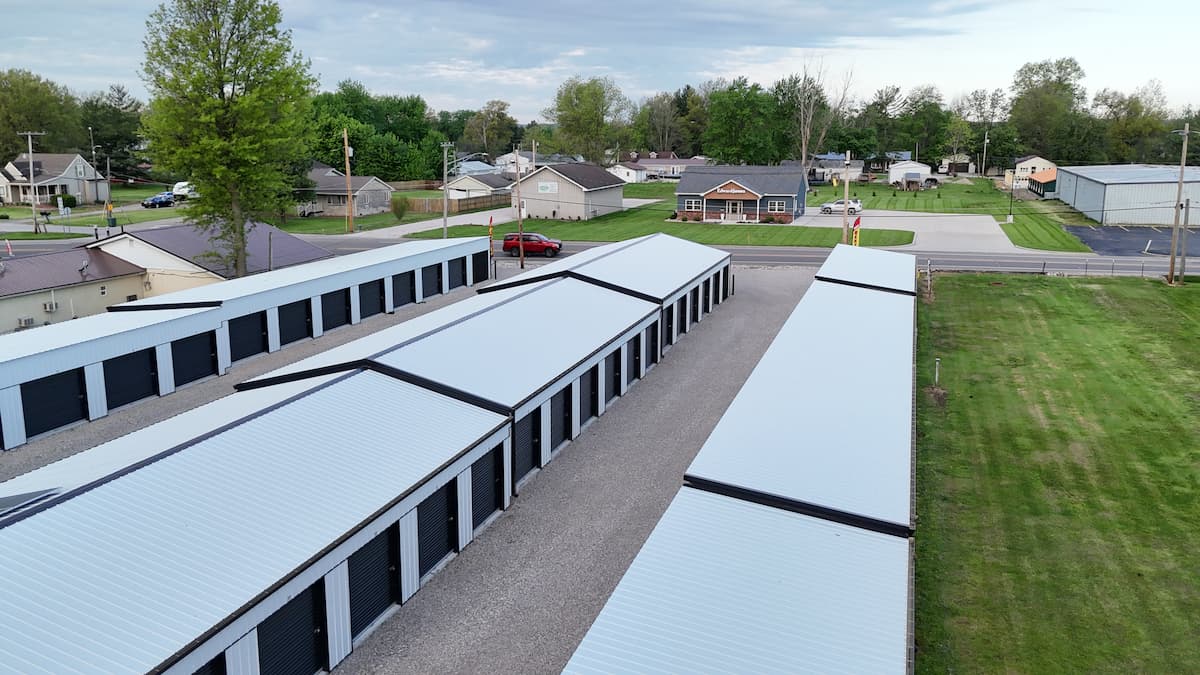
Extra Space Storage operates a prominent self-storage campus on Airline Highway in Baton Rouge, Louisiana, serving the capital city's growing population and the commercial corridor connecting downtown to the north Baton Rouge neighborhoods. The Louisiana storage market is among the most climate-stressed in the country — hot, humid weather persists for eight or nine months of the year, hurricane season runs June through November, and the state's position in a high-rain region means that roofing failures on storage facilities translate quickly into tenant loss claims and insurance disputes. Operators in the Baton Rouge market have learned that investing in quality roofing upfront is far less costly than dealing with the aftermath of a wet summer and a leaking roof.
Louisiana's extreme humidity is the defining challenge for Baton Rouge storage roofing. Annual average relative humidity exceeds 75 percent, and summers deliver sustained heat indices above 105°F. This combination accelerates biological growth — algae, moss, and mold — on roofing surfaces that are not treated with algae-resistant formulations. It also drives moisture vapor into roof assemblies through any imperfection in the vapor control layer, leading to insulation degradation and deck corrosion in steel-framed storage buildings. Roofing contractors working in Baton Rouge specify fully adhered TPO with integrated vapor retarders and biocide-treated membranes as standard practice on storage facility projects.
Hurricane season creates a different risk profile for Baton Rouge storage facilities than for coastal Louisiana properties, but it is far from irrelevant. Baton Rouge sits roughly 80 miles from the Gulf Coast — close enough that major hurricanes retain significant wind speeds as they track inland. Hurricane Ida in 2021 caused substantial roofing damage across the Baton Rouge metro, and storage facilities with inadequately fastened perimeter edge metal and membrane systems sustained preventable losses. Wind uplift design for storage roofs in East Baton Rouge Parish should reflect the city's exposure to tropical systems, not just standard continental wind loads.
Climate-controlled storage in Baton Rouge faces year-round cooling demand and the moisture management challenge unique to hot-humid climates. The roof assembly's vapor control layer must prevent the extremely moist outdoor air from condensing on the cool interior surfaces of climate-controlled storage buildings. A building with a properly designed and installed vapor control layer will maintain comfortable interior conditions and protect stored electronics, wood furniture, and sensitive items; a building without adequate vapor control will develop condensation, mold, and musty odors that damage tenant relationships and create liability exposure.
Tenant belongings protection during Baton Rouge roofing work must account for the city's frequent afternoon thunderstorms and the genuine risk of named storm systems during hurricane season. A contractor who accepts a large storage campus project in July or August in Baton Rouge is accepting work during peak tropical risk season. The project schedule should include explicit protocols for what happens when a tropical watch or warning is issued — how quickly can open sections be secured, where does materials staging go, and who makes the stop-work decision? These questions should be answered before work begins, not during a scramble to secure the site as a storm approaches.
Drainage design for Baton Rouge storage campuses must be capable of handling Louisiana's extraordinary rainfall intensity. Baton Rouge is one of the wettest large cities in the United States, averaging over 60 inches of precipitation annually, much of it delivered in high-intensity events. The Great Flood of 2016 — a non-tropical rainfall event that deposited 20+ inches over three days in the Baton Rouge area — demonstrated that storage facilities with adequate rooftop drainage but inadequate site grading and stormwater management can still flood from external water sources. A complete drainage evaluation for a Baton Rouge storage campus considers both rooftop and site-level water management.
Security penetrations at Baton Rouge storage facilities are subject to accelerated weathering from the city's extreme humidity and heat. Sealants that would last a decade in a dry climate may need replacement in five to seven years in Louisiana's environment. Operators should budget for penetration inspection and resealing as a routine maintenance item — annual inspection is appropriate for Baton Rouge's conditions, compared to every two to three years in less demanding climates. Roofing contractors who provide maintenance agreements with their installation work are offering a genuine value-add in this market.
EPDM has a strong track record in Louisiana's hot-humid climate, particularly in ballasted applications where the stone provides UV protection and thermal mass that moderates daily temperature cycling on the membrane surface. However, ballasted systems present a debris challenge during hurricane events, when high winds can mobilize rooftop ballast and turn it into a projectile hazard. Some Baton Rouge operators and insurers have moved away from ballasted systems in favor of fully adhered TPO specifically because of hurricane wind risk and the rooftop debris issue.
Louisiana's contractor licensing board requires commercial roofing contractors to be licensed with the state, which provides storage operators with at least a minimum vetting mechanism. However, licensed status does not guarantee quality or experience with the specific conditions of Baton Rouge storage facility roofing — the humidity, hurricane wind design, and tropical rainfall intensity that distinguish this market from most others. Operators should ask for references from comparable Louisiana storage projects and verify that bidding contractors are familiar with the state's specific roofing design requirements for hurricane-exposed regions.
- How does Louisiana's humidity affect roofing material durability in Baton Rouge?
- Sustained high humidity accelerates biological growth, sealant degradation, and moisture vapor infiltration into roof assemblies. Biocide-treated membranes, integrated vapor retarders, and more frequent maintenance inspection cycles are appropriate responses for Baton Rouge storage projects.
- What wind design standards apply to Baton Rouge storage roofs for hurricane exposure?
- East Baton Rouge Parish falls within a region that must account for tropical cyclone wind loads. FM uplift ratings and ASCE 7 hurricane wind speed contours should guide fastening pattern design, with enhanced perimeter and corner zone requirements.
- Should Baton Rouge storage operators avoid ballasted roofing systems?
- Many do. During hurricane events, ballast can become a projectile hazard. Fully adhered TPO eliminates this risk while meeting uplift requirements. Insurers may have opinions on ballasted versus adhered systems; check with your carrier before specifying.
- How should a contractor handle a tropical storm warning during active roofing work?
- Project contracts should include explicit tropical weather protocols: defined trigger points (watch vs. warning), maximum allowed open area, emergency securing procedures, and stop-work authority. These should be agreed upon before mobilization, not improvised during the event.
- What drainage capacity is appropriate for a Baton Rouge storage campus?
- Size for the 100-year storm intensity in Baton Rouge, which is among the highest in the country. Overflow scuppers should be sized and positioned as a true backup, not an afterthought. Annual drain cleaning is essential given the region's debris load from frequent high-wind events.